Sunday, 28 February 2016

Electron Transport Chain

The process of photosynthesis is completed in two main steps - light reaction and dark reaction. Light reaction occurs in the thylakoids of the chloroplast. This phase requires light for chemical reactions therefor, called photochemical phase. Dark reaction occurs in the stroma region of the chloroplast and does not require any light for the reaction to complete. Therefor, it is also called thermochemical phase. Light reaction begins as soon as the light falls on green leaves. It results in the excitation of electrons and facilitates the downhill journey of these electron with the synthesis of ATP molecules. This process is called photophosphorylation. Two photosystems are involved in the light reaction or in the synthesis of ATP molecules. P700 or photosystem I participated in the cyclic photophosphorylation and both photosystem I and photosystem II are associated in a non-cyclic photophosphorylation. The two photosystems are connected with each other by electron transport chain.
Electron transport chain:- It was first described by Hill in 1939. Electron transport chain is a series of electron carriers over which electron pass downhill journey and releasing energy at each step which helps in the synthesis of ATP. Photosynthesis electron transport chain has two main components connected to each other photosystem I and photosystem II. P680 or Photosystem II absorbs light energy and get excited. Excited photosystem transfer electron to the next carrier phaeophytin. after losing the electron photosystem II will become strong oxidant ( who has the ability of taking electron from others is called oxidant). Meanwhile the photolysis of water or splitting of water will provide the electron to the deficient photosystem II ( Photlysis is the splitting of water in the light which results in the release of molecular oxygen during the process). Phaeophytin after accepting electron becomes strong reducing agent ( who is ready to gives extra electrons to others). Then phaeophytin donates its electron to downhill carriers of ETC. At the end plastocyanin will transfer electrons to P700 or photosystem I.  P700 will hand over electrons to special chlorophyll molecule X from where electron transfer first to the iron sulphur protein (FeS) and then to the protein ferrodoxin (Fd). The latter can pass electron to the reductase coplex which helps in reducing NADP+ to NADPH. In electron transport chain two main events are involved first the production of ATP and second the release of molecular oxygen into atmosphere.
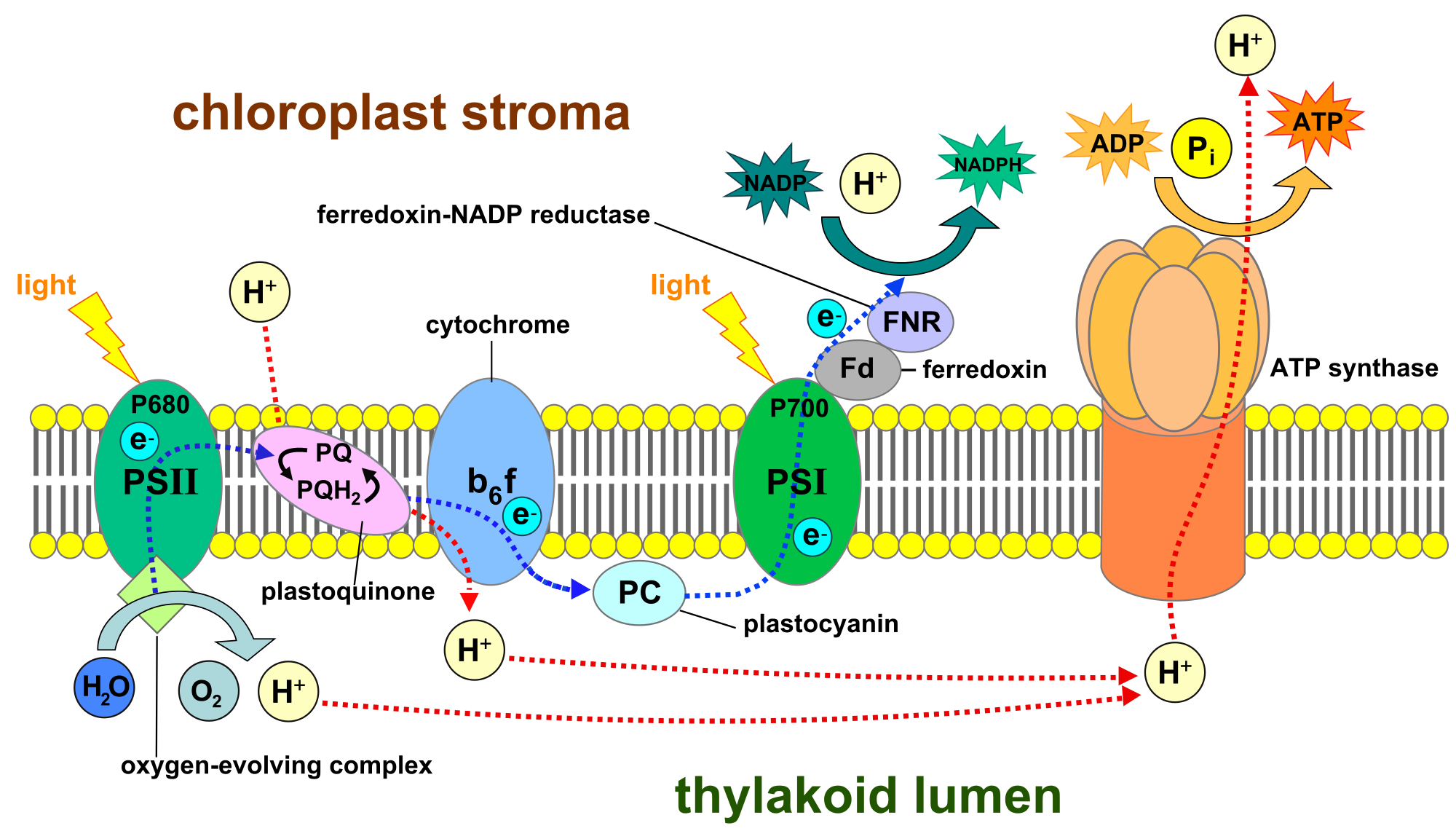


                            Electron transport pathway in photosynthesis involving two phosystems


Tuesday, 23 February 2016

Photosystems or Pigment Systems

    Photosynthesis involve the participation of two distinct groups called photosystem I and      photosystem II. Each photosystem has a pigment protein complex composed of chlorophyll a, chl b, carotenoids and other components required for electron transport during light reaction. These pigment systems are as fllows:-

Photosystem I (PS I) :- It is a photosynthetic pigment system with some electron carriers is present on both nonappressed part of the grana thylakoids as well as on the stroma thylakoids. This system has more chlorophyll a molecules and chlorophyll b and carotenoids are less.  Photosystem I consists of a photocentre, light harvesting complex and some electron carriers. Photocentre contains molecules of chlorophyll a700 and P700 ( a special chlorophyll molecules that absorb visible light near 700 nm wavelength). PS I has a reducing agent A0, A1, Fe Sx, Fe SA and Fe SB ( iron sulphur protein), Fd ( ferrodoxin), cytochrome b6 - f complex and plastocyanin. PS I takes part in both cyclic and non cyclic photophosphorylation ( it is the synthesis if ATP in the presence of sunlight). PS I can carry cyclic photophosphorylation independently.photosys


Photosystem II :- It is a photosynthetic pigment system present in appressed part of the thylakoid. PS II contains a chl a, chl b and carotenoids. Chl a and b are in equal content. PS II complex contains a molecule of chl a680 or P680  ( a special chlorophyll a molecule that absorb visible light near 680 nm wavelength).  Carotenoids are higher as compared to PS I. PS II consists of a photocentre, oxygen evolving complex, light harvesting comples and some electron carriers. Oxygen evolving complex contains a Mn2+, Ca2+ and Cl ions. PS II is only participate in the non cyclic photophosphorylation. 


Thursday, 18 February 2016

Photosynthetic Units

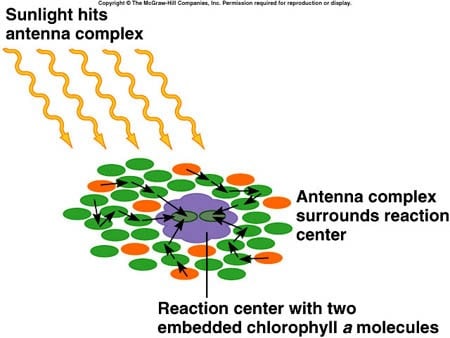
A photosynthetic unit is a small group of pigment molecules which takes part in photochemical reaction and changing light energy into chemical energy. In one unit there will be one photocentre or reaction centre which will be feed by about 200 harvesting pigment molecules. The photocentre consists of special chlorophyll a molecules, P700 and P680. Reaction centre absorbs light energy at longer wavelength. Harvesting molecules are also called light harvesting complex ( LHC). There are different LHCS for two photosystems I and II. Two types of molecules are presesnt in LHC these are called antenna molecules and core molecules. The antenna molecules absorbs variou wavelength of light shorter than photocentre. After absorbtion antenna molecules get excited and in excited form these molecules hand over energy to core molecules by resonance and come to ground state. The energy from core molecules will supply to the photocentre. On absorbtion of light energy photocentre get excited and by changing the state of electrons from excited to again grond state helps the photocentre to change the light energy to chemical energy. The frequency of excitation of photocentre is very high so it cannot meet by direct absorption of energy.


                                                   Harvesting of light by photosynthetic unit


Friday, 25 December 2015

Photosynthetic Pigments

Photosynthetic pigments are present in thylakoids of chloroplast and helps in the absorption of light during photosynthesis. Therefore, photosynthetic pigments are very important for the process of photosynthesis. There are two types of pigments present in green plants -

i) Chlorophylls
ii) Carotenoids

i) Chlorophylls:- These are green pigments mainly involved in the conversion of light energy into chemical energy ( formation of glucose). There are five types of chlorophyll pigments are present in plants. These are chlorophyll a, b, c, d and e. Chlorophyll a and b are present in higher plants. Chlorophyll a is present in all types of photosynthetic organisms except bacteria ( This pigments is found in all oxygen evolving photosythetic plants). Hence, It is named as universal chlorophyll pigment. Chlorophyll a directly takes part in photochemical reactions. Therefore, it is also known as the primary photosythetic pigmen. Other photosynthetic pigments including chlorophyll b, c, d, e, carotenoids and phycobilins are called accessory pigments because they are not diectly involved in photochemical reactions and can absorb the light of different wavelengths and transfer energy finally to chlorophyll a through electron spin resonance.
                              The empirical formula of chlorophyll a is C55H72O5N4Mg and it differs from Chlorophyll b by one methyl group (-CH3) and chlorophyll b will have aldehyde group (-CHO) Therefore, chlorophyll b's empirical formula is C55H70O6N4Mg. The empirical formula for bacteriochlorophyll is C55H74O6N4Mg.
                                                       Structure of chlorophyll molecule was studied by Wilstatter, Stroll and Fischer in 1912. Each chlorophyll molecule have a tadpole like configuration consists of porphyrin head and phytol tail. The porphyrin head is made up of four pyrrol rings and interconnected by methane group. In the center of pyrrol rings divalent Mg is present. The phytol tail consists of 20 carbon long chain.


Carotenoids:- carotenoids are yellow, brown, orange or reddish pigments found in photosynthesizing cells. The carotenoids also provide colour to the fruits and flowers because they are present in the chromoplasts. These different colours of flowers will attract the insects and pollination will takes place. ( Pollination is the transfer of the pollen grain from anther to stigma ). Carotenoids are of two types:-
a) Carotenes 
b) Xanthophylls
a) Carotenes:- These are unsaturated hydrocarbons with general formula of C40H56. The most common carotene is beta carotene present in good amount in carrot which is converted into vitamin A by liver in animals and human beings. 
b) Xanthophylls:- These are Zeaxanthin and Lutein. lutein is responsible for yellow colour in autumn foliage.


Thursday, 12 November 2015

Raw materials for photosynthesis

Photosynthesis is a process in which there is a synthesis of bio molecules e.g. sugar molecules. Therefore, for the synthesis of bio molecules raw material is required by the plant. Raw material for the photosynthesis is carbon-dioxide, water, sunlight and chlorophyll.

Carbon Dioxide:- Carbon dioxide present in atmosphere is normally obtained by the plants through stomata. Carbon dioxide enters into the plant by simple diffusion. Small quantities of carbonates are also absorbed by the plants from soil. Hydrophytes ( aquatic plants ) gets carbon dioxide from the water in the form of bicarbonates.


                                                                     Photosynthesis 

Water:- Water plays very important role in any physiological reactions. ( physiology is the study of functions in living things ). Van Niel proved that some bacteria used H2S as a reducing power while working on photosynthetic bacteria. Therefor, in these bacteria instead of evolution of oxygen sulphur globule accumulated as a waste material.


                                  6CO2  +  12H2O        --------------     C6H12O6   +    6H2O   +   12S

Robin Hill illuminated the isolated chloroplast to sunlight and even in the absence of CO2 he found that chloroplast evolved oxygen during photosynthesis.

                                    2A ( hydrogen acceptor)  +  2H2O   ----------------  2AH2  +  O2

These hydrogen acceptor are also called Hill Oxidants and because oxygen is evolved during the illumination of chloroplast to sunlight even in the absence of CO2 is called Hill Reaction.
Ruben et al ( 1941 ) proved that oxygen evolved during photosynthesis comes from H2O by suspended Chlorella in water having heavy isotope of oxygen O18 .

                                                                           Light
                     6CO2  +  12H2O18                  ----------------               C6H12O6  +  6H2O  +  6O18
                                                               Chlorophyll, enzymes


Light:- Light is the visible part of electromagnetic radiations. Visible light have the wavelength from 390 to 760 nm. This is made up of different colours of wavelength starting from violet to red light. These are violet ( 390-430nm), blue or indigo ( 430-470nm), blue green ( 470-500nm), green ( 500-580), yellow ( 580-6800, orange ( 600-650), red ( 650- 760). This is also called VIBGYOR. Photosynthesis used wavelength from 400-700nm. These radiations are called photosynthetic active radiatios ( PAR ). Blue and green light is the most effective radiations for photosynthesis. Maximum absorption of these wavelength of light takes place during photosynthe.

Chloroplast :- Already mentioned in detail. This organelle contains photosynthetic pigments so plays vital role in photosynthesis.


Sunday, 1 November 2015

Reproduction

Reproduction is a biological process in which organisms produces their own kind of individuals. Reproduction is the most typical character of living beings. In other words it is the process in which species maintains their survival on this earth by producing the young ones of the same species.

Purpose of reproduction:-
i) Reproduction maintains the continuity of species.
ii) It is the process in which any population able to maintain the young, adults and aged individuals.
iii) Reproduction helps to bring the variations among any specie which helps that specie for adaptation and evolution for changing surrounding conditions.
iv) Life is possible on this earth because of reproduction.

Types of Reproduction:- Basically there are two types of reproduction found in the living organisms. These are
   
               a) Asexual Reproduction
               b) Sexual Reproduction

a) Asexual Reproduction:- It is the reproduction in which there is only single parent involved in the process or without the fusion of male and female gametes ( involvement of male and female gametes occurs in the sexual reproduction). In this type the organisms produced will be the exact copies of parent.  These individuals are called clones because they are genetically and morphologically similar to their parent.
Main features of asexual Reproduction
i) There will be a single parent.
ii) There will not be a gamete formation.
iii) fertilisation will be absent.
iv) No meiosis will takes place only mitosis will be present.
v) Because there is no fusion of the gametes of two different parents so no variation or daughter individuals are genetically identical to the parent.
vi) Multiplication occurs rapidly.

Asexual reproduction is normally the character of unicellular organisms like monerans and protists and in plants and in certain animals.

b) Sexual reproduction:- It is a reproduction in which new individuals are formed through the formation and fusion of male and female gametes. This process is also called amphimixis ( both parents's gametes are mixing together). Actually sexual reproduction has four main steps:-

i) Formation of gametes through the division of meiosis. this is called gametogenesis or this is the formation of haploid cells. ( 1N )
ii) Fusion of two gametes forming the diploid cell ( 2N ) zygote. This fusion is called fertilisation.
iii) Repeated mitotic divisions of zygote for the formation of embryo.
iv) Growth of the embryo into full individual.

Main features of Sexual reproduction:-
i) Two parents are involved therefor, it is usually biparental.
ii) There is always formation of gametes.
iii) It involves both meiosis and mitosis.
iv) New individuals formed will be different from their parents.
iv) Multiplication is not so rapid as in case of sexual reproduction.


Photosynthesis

Photosynthesis is an enzymatic controlled anabolic process in which there is a synthesis of organic compounds inside the chlorophyll containing cells from the water and CO2 in the presence of sunlight.
                                                           OR
Photosynthesis is a process in which green plants makes their own food in the presence of sunlight from the H2O and CO2 with the help of chlorophyll molecules.
                                                           OR
Photosynthesis is a process in which there is a conversion of light energy into chemical energy.   

                        6CO2 + 12H2O + Light Energy → C6H12O6 + 6O2 + 6H2O


 The function of water is to provide hydrogen for the synthesis of organic compounds and liberation    of oxygen during the process. 
 The organisms which has the ability to perform photosynthesis are called photoautotrophs. All green plants, cyanobacteria, algae and many protists are photoautotrophs. 

Importance
i) Photosynthesis is the only process in which synthesis of organic molecules from the inorganic raw material is possible.
ii) Photosynthesis plays very important role in releasing oxygen into atmosphere to compensate for O2 using through the process of respiration. It helps in maintaing the balance between O2 and CO2 level in the atmosphere.
iii) All heterotrophs are depends on photoautotrophs for their food requirements. 
iv) All types of fossil fuels like coal, petroleum and natural gas are the results of photosynthesis.
v) Many plant products are very useful like timber for making furniture, doors and windows, rubber, resins, drugs, oils, fibres etc.
vi) Crops productivity is directly dependent upon the rate of photosynthesis.