Thursday, 12 November 2015

Raw materials for photosynthesis

Photosynthesis is a process in which there is a synthesis of bio molecules e.g. sugar molecules. Therefore, for the synthesis of bio molecules raw material is required by the plant. Raw material for the photosynthesis is carbon-dioxide, water, sunlight and chlorophyll.

Carbon Dioxide:- Carbon dioxide present in atmosphere is normally obtained by the plants through stomata. Carbon dioxide enters into the plant by simple diffusion. Small quantities of carbonates are also absorbed by the plants from soil. Hydrophytes ( aquatic plants ) gets carbon dioxide from the water in the form of bicarbonates.


                                                                     Photosynthesis 

Water:- Water plays very important role in any physiological reactions. ( physiology is the study of functions in living things ). Van Niel proved that some bacteria used H2S as a reducing power while working on photosynthetic bacteria. Therefor, in these bacteria instead of evolution of oxygen sulphur globule accumulated as a waste material.


                                  6CO2  +  12H2O        --------------     C6H12O6   +    6H2O   +   12S

Robin Hill illuminated the isolated chloroplast to sunlight and even in the absence of CO2 he found that chloroplast evolved oxygen during photosynthesis.

                                    2A ( hydrogen acceptor)  +  2H2O   ----------------  2AH2  +  O2

These hydrogen acceptor are also called Hill Oxidants and because oxygen is evolved during the illumination of chloroplast to sunlight even in the absence of CO2 is called Hill Reaction.
Ruben et al ( 1941 ) proved that oxygen evolved during photosynthesis comes from H2O by suspended Chlorella in water having heavy isotope of oxygen O18 .

                                                                           Light
                     6CO2  +  12H2O18                  ----------------               C6H12O6  +  6H2O  +  6O18
                                                               Chlorophyll, enzymes


Light:- Light is the visible part of electromagnetic radiations. Visible light have the wavelength from 390 to 760 nm. This is made up of different colours of wavelength starting from violet to red light. These are violet ( 390-430nm), blue or indigo ( 430-470nm), blue green ( 470-500nm), green ( 500-580), yellow ( 580-6800, orange ( 600-650), red ( 650- 760). This is also called VIBGYOR. Photosynthesis used wavelength from 400-700nm. These radiations are called photosynthetic active radiatios ( PAR ). Blue and green light is the most effective radiations for photosynthesis. Maximum absorption of these wavelength of light takes place during photosynthe.

Chloroplast :- Already mentioned in detail. This organelle contains photosynthetic pigments so plays vital role in photosynthesis.


Sunday, 1 November 2015

Reproduction

Reproduction is a biological process in which organisms produces their own kind of individuals. Reproduction is the most typical character of living beings. In other words it is the process in which species maintains their survival on this earth by producing the young ones of the same species.

Purpose of reproduction:-
i) Reproduction maintains the continuity of species.
ii) It is the process in which any population able to maintain the young, adults and aged individuals.
iii) Reproduction helps to bring the variations among any specie which helps that specie for adaptation and evolution for changing surrounding conditions.
iv) Life is possible on this earth because of reproduction.

Types of Reproduction:- Basically there are two types of reproduction found in the living organisms. These are
   
               a) Asexual Reproduction
               b) Sexual Reproduction

a) Asexual Reproduction:- It is the reproduction in which there is only single parent involved in the process or without the fusion of male and female gametes ( involvement of male and female gametes occurs in the sexual reproduction). In this type the organisms produced will be the exact copies of parent.  These individuals are called clones because they are genetically and morphologically similar to their parent.
Main features of asexual Reproduction
i) There will be a single parent.
ii) There will not be a gamete formation.
iii) fertilisation will be absent.
iv) No meiosis will takes place only mitosis will be present.
v) Because there is no fusion of the gametes of two different parents so no variation or daughter individuals are genetically identical to the parent.
vi) Multiplication occurs rapidly.

Asexual reproduction is normally the character of unicellular organisms like monerans and protists and in plants and in certain animals.

b) Sexual reproduction:- It is a reproduction in which new individuals are formed through the formation and fusion of male and female gametes. This process is also called amphimixis ( both parents's gametes are mixing together). Actually sexual reproduction has four main steps:-

i) Formation of gametes through the division of meiosis. this is called gametogenesis or this is the formation of haploid cells. ( 1N )
ii) Fusion of two gametes forming the diploid cell ( 2N ) zygote. This fusion is called fertilisation.
iii) Repeated mitotic divisions of zygote for the formation of embryo.
iv) Growth of the embryo into full individual.

Main features of Sexual reproduction:-
i) Two parents are involved therefor, it is usually biparental.
ii) There is always formation of gametes.
iii) It involves both meiosis and mitosis.
iv) New individuals formed will be different from their parents.
iv) Multiplication is not so rapid as in case of sexual reproduction.


Photosynthesis

Photosynthesis is an enzymatic controlled anabolic process in which there is a synthesis of organic compounds inside the chlorophyll containing cells from the water and CO2 in the presence of sunlight.
                                                           OR
Photosynthesis is a process in which green plants makes their own food in the presence of sunlight from the H2O and CO2 with the help of chlorophyll molecules.
                                                           OR
Photosynthesis is a process in which there is a conversion of light energy into chemical energy.   

                        6CO2 + 12H2O + Light Energy → C6H12O6 + 6O2 + 6H2O


 The function of water is to provide hydrogen for the synthesis of organic compounds and liberation    of oxygen during the process. 
 The organisms which has the ability to perform photosynthesis are called photoautotrophs. All green plants, cyanobacteria, algae and many protists are photoautotrophs. 

Importance
i) Photosynthesis is the only process in which synthesis of organic molecules from the inorganic raw material is possible.
ii) Photosynthesis plays very important role in releasing oxygen into atmosphere to compensate for O2 using through the process of respiration. It helps in maintaing the balance between O2 and CO2 level in the atmosphere.
iii) All heterotrophs are depends on photoautotrophs for their food requirements. 
iv) All types of fossil fuels like coal, petroleum and natural gas are the results of photosynthesis.
v) Many plant products are very useful like timber for making furniture, doors and windows, rubber, resins, drugs, oils, fibres etc.
vi) Crops productivity is directly dependent upon the rate of photosynthesis.


Thursday, 22 October 2015

Nucleus

Nucleus is a double membrane protoplasmic organelle which is present in all eukaryotic cells except mature sieve cells of vascular plants and red blood cells of mammals. Nucleus plays a very important role to regulate metabolic activities of the cell as well as also involved in the transmission of characters from one generation to another. Nucleus is a organelle which containg genetic material or genes which are responsible for all functioning of cell.
                                                                               Nucleus was first observed by Leeuwenhoek in red blood cells of fish, was first studied by Robert Brown (1831) in orchid root cells. A typical nucleus is absent in the prokaryotic cells instead of typical nucleus prokaryotic cells have their genetic material or nucleus without a nuclear membrane called nucleoid.  
                                       
    Nucleus is usually centrally located in the cell and normally a cell will have one nucleus. But in some cases their number also vary like binucleated cells ( cell with two nucleus) e.g. Paramecium caudatum, multinucleated cells (cells with multiple number of nucleus) also called syncytial cells or coenocytic cells e.g. Rhizopus, Vaucheria. 

Ultrastructure:- These are following components of nucleus which plays very important role in the functioning of nucleus:-
i) Nuclear Envelop:- A typical is always bounded by outer covering called nuclear envelop which separates the nucleus from cytoplasm. This nuclear envelop is made up of double membranes inner and outer membrane. These membranes are trilaminar and made up of lipoproteins. A perinuclear space is present between the two membranes. Inner membrane of nucleus is smooth but outer membrane because of presence of endoplasmic reticulum becomes rough. Nuclear envelop contains a large number of pores. Because nuclear membranes are immpermeable to large biomolecules these pores functions as a channels and create connection between cytoplasm and nucleoplasm (nuclear sap). In some cases 10%  of the envelop is occupied by nuclear pores.
ii) Nucleoplasm:- It is a fluid present in the nucleus. This fluid is normally transparent, semifluid and containing colloidal substances. Nucleoplasm has number of the enzymes like DNA polymerase, RNA polymerase and nucleoside phosphorylases. These enzymes plays very important role in the various functions of nucleus.
iii) Nuclear matrix:- This is a network of fine fibrils of proteins that functions as scaffold for chromatin. Nuclear matrix is dense and making fibrous layer just below the nuclear envelop called nuclear lamina. Terminal ends of chromatin fibres embedded in this region of nucleus. It is also important because it provides mechanical strength to the nuclear envelop and also a attachment sites to telomeric sites.


                                                  Sectional view of nuclear envelop

iv) Chromatin:- Chromatin is a complex of macromolecules which is names after its ability to get stained with certain basic dyes. Chromatin fibres are distributed throughout the nucleoplasm. They are differentiated into two regions - Euchromatin and heterochromatin. Euchromatin is usually light stained part which forms the bulk of the chromatin. The dark stained part is called heterochromatn. The whole chromatin is not functional but the portion of the euchromatin associated with the acid proteins takes part in transcription ( synthesis of RNA).
Nucleolus:- It is rounded, naked and slightly irregular structure which is attached to the chromatin at specific region called nucleolar organiser region. Because of the absence of covering membrane around it Ca ion are involved in the maintenance of configuration.
                                     The size of the nucleolus is directly related to the synthetic activities of the cell.


                                                       Ultrastructure of Nucleolus

Nucleolus is the principal site for the development of ribosomal RNA. Therefor, it is the center of the formation of ribosomal components. It also plays role in the cell division.
Functions of Nucleus:- 
i) It is very essential organelle of the cell because it contains genetic material in the form of DNA.
ii) It is the region which takes part in controlling all cellular activities.
iii) The DNA present in the nucleus is responsible for the passage of characters from one generation to next generation.
iv) Variation are also result of the changing in the genetic material or mutation are also the result of change on genetic material.
v) Ribosome precursors are also formed in the nucleolus which is the part of nucleus.


Thursday, 15 October 2015

Guttation

Guttation is process in which there is a loss of water in the form of water droplets from the leaves and other parts of uninjured plant. It was first discovered by Bergerstein in 1887. Guttation occurs through special structures called hydathodes. 
                                       The big difference between transpiration and guttation is that the evaporated water through transpiration is always pure but in case of guttation the liquid will never be pure water. It contains 0.6-2.5 gm/litre of solutes both organic and inorganic solutes. Normally guttation takes place during night and during morning. Most of the time guttation is mistaken by dew drops but keep in mind that droplets because of guttation is always present on the margins and at the tips of the leaves. Hydathodes are structures made up of loosely arranged colourless parenchymatous cells called epithem. Exudation of water is because of positive pressure in the xylem tissue. Because of this pressure the liquid forced out through hydathodes. Actually during day time because of open stomata excess of water could be evaporated through transpiration. But during night when stomata is closed excess of the water is forced to the outside through guttation. guttation is also shown by plants during high humid climate.


Guttation is not present in all types of plants. Trees because of great height are unable to develop to much pressure in the xylem that it creates forces and push excess of water to the outside through hydathodes. Non-woody plants, grasses, some vascular plants and shrubs less than 3 feet height usually show guttation.

Bleeding:- It is the exudation of liquid or sap from the injured parts of the plant. Bleeding occurs because of root pressure, phloem pressure and xylem pressure.


Thursday, 8 October 2015

Mechanism of Stomatal Movements

Stomata are the pores which takes part in the transpiration that means evaporation of water from these pores and also play important role in the gaseous exchange during photosynthesis and respiration. Stomatal movements are regulated by the change of turgor pressure in the guard cells or in other way stomata functions as turgor-operated valves. Guard cells will swell up by absorption of water and walls will stretch up with result of opening of stomata.  Stomata generally opens during day time and closed during night time. The conditions required for the opening of stomata during day time are like light, high pH, low concentration of CO2 and availability of water. Likewise during night time stomata will close because of darkness, low pH, high CO2 concentration and dehydration. Mechanism of stomatal opening is described by three main theories :-

i) Hypothesis of guard cell photosynthesis:- This theory was given by Schwendener in 1881. According to this hypothesis guards cells have choroplast and during day time these chloroplast show photosynthesis as a result of photosynthesis sugar molecules produced. This sugar will increase the osmotic pressure inside the guard cells. Because of Osmotic pressure guard cells will start to absorb water from the near epidermal cells. Due to turgor pressure stomata will open. however the photosynthetic activities of guard cells are very less so this was not accepted very much.

ii) Classical starch hydrolysis theory:-  This theory was spelled out by Sayre in 1923 and then modified by steward in 1964. According to this theory guard cells contain starch. during day time when CO2 concentration is low (in the day time because of photosynthesis the CO2 concentration is low) and the pH of the guard cell will increase then enzyme phosphorylase will become active then this enzyme converts the starch present in the guard cells to glucose 1-phosphate. Then glucose 1-phosphate will change into glucose 6-phosphate and latter this molecule after hydrolysis converts into glucose and phosphoric acid.

                                                         phosphorylase
             Starch + nH3PO4                                     =                              n Glucose 1-phosphate

                                                    phosphoglucomutase
             Glucose 1-phosphate                     =                        Glucose 6-phosphate

                                                             phosphatase
            Glucose 6-phosphate + water         =                         Glucose + H3PO4


 Glucose increases osmotic pressure of the guard cells and guard cells will start to absorb water from the adjacent cells and stomata will open. During night time reverse reaction will take place and due to formation of starch the osmotic concentration of guard cells will decrease and guard cells with loss of water will shrink and then closed. But this was not accepted because
i) Glucose is not found in the guard cells at the time of stomatal opening.
ii) The starch and glucose conversion is usually slow reaction but stomatal movements are rapid.


iii) Malate or K+ ion Pump Hypothesis:- This theory was put forward by Steward in 1974. This theory explains that during day time the pH of the guard cell increases due to absorption of H+ ion concentration in the guard cell. CO2 concentration is less due to its assimilation by mesophyll cells. An increase in pH causes the hydrolysis of starch into organic acids.

Starch --- Hexose Phosphate --- Phosphoglyceric acid --- Phosphoenol Pyruvate

Phosphoenol pyruvate is also the intermediate product of respiratory pathway. So with the help of PEP carboxylase the phosphoenol pyruvate will combine with CO2 forms oxalic acid. Latter this organic acid gets changed into malic acid. Malic acid dissociates into malate and H+ ions. H+ ions will pass out from the guard cells with the exchange of K+ ions. These ions and malate ions will increases the osmotic pressure inside the vacuoles of guard cells and as a result water gets absorbed by the guard cells and stomata will open. In the dark reverse reaction taks place and stomata will closed.


                                           Role of K+ ions in Opening and Closing of Stomata


Tuesday, 6 October 2015

Ribosomes

Ribosomes were first discovered by Robinson and Brown (1953) in plant cell and by Palade (1955) in animal cell. Palade also named these as ribonucleo-protein particles. atherefore, Ribosomes are naked ribonucleoprotein protoplasmic particles which functions as the sites of protein and polypeptide synthesis. Ribosomes are also called Protein Factories. These are spherical microscopic bodies found in all living cells except mammalian red blood corpuscles. 


    Ribosomes in prokaryotic and eukaryotic cells are differ in their RNA and protein molecules. Each ribosomes consists of two unequal subunits, larger and smaller subunit. The smaller subunit fits over a larger subunit as a cap. The two subunits usually lies freely in the cytoplasm of the cell but both subunits will get associate at the time of polypeptide synthesis and Mg ions are required for this association. 
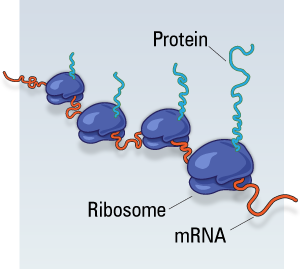
                                                                              Ribosomes may occur singly are called monosomes but during protein synthesis number of ribosomes participated or in other words when there is synthesis of number of same type of polypeptides over ribosomes then they are interconnected by strand of mRNA and collectively are known as the Polyribosomes. Ribosomes are present in cytoplasm of the cell and in the organelles. The organelle ribosomes are present in the plastids and mitochondria. Because of the presence of their own ribosomes and DNA these organelle are able to synthesis some types of proteins. Therefore, these organelles are also called semi-autonomous organelles. The cytoplasmic ribosome may be free or attached to the ER. Different types of ribosomes are involved in the synthesis of different types of proteins e.g. structural proteins from free ribosomes and globular proteins from robosomes bound to ER. 


                                                                             Polyribosome


The size of the ribosomes is determined by sedimentation coefficient in the centrifuge. Two types of ribosomes are found in prokaryotic and eukaryotic cells on the basis of their sedimentation coefficient. In eukaryotic cells the nature of ribosome is 80S and it has two sununits larger 60S and smaller 40S likewise prokaryotic cells have 70S ribosomes and they have larger subunit 50S and smaller 30S. 
         Chemically a ribosome is made up of two parts, proteins and rRNA. The principal site of the synthesis of ribosomal RNA is nucleolus region in the nucleus of the cell. The ribosomal proteins seem to be synthesized in the cytoplasm but migrated to the nucleoli for the formation of ribosomes.

Functions:- i) Ribosomes are the organelles involved the protein synthesis.
ii) Free ribosomes synthesise structural and enzymatic proteins for use inside the cell and attached ribosomes synthesise proteins for transport.